FIFTEEN RARE IBISES FOLLOWED A PLANE SOUTH.
Human foster parents flew ahead. Fifteen young ibises followed them into a new Spanish flock.
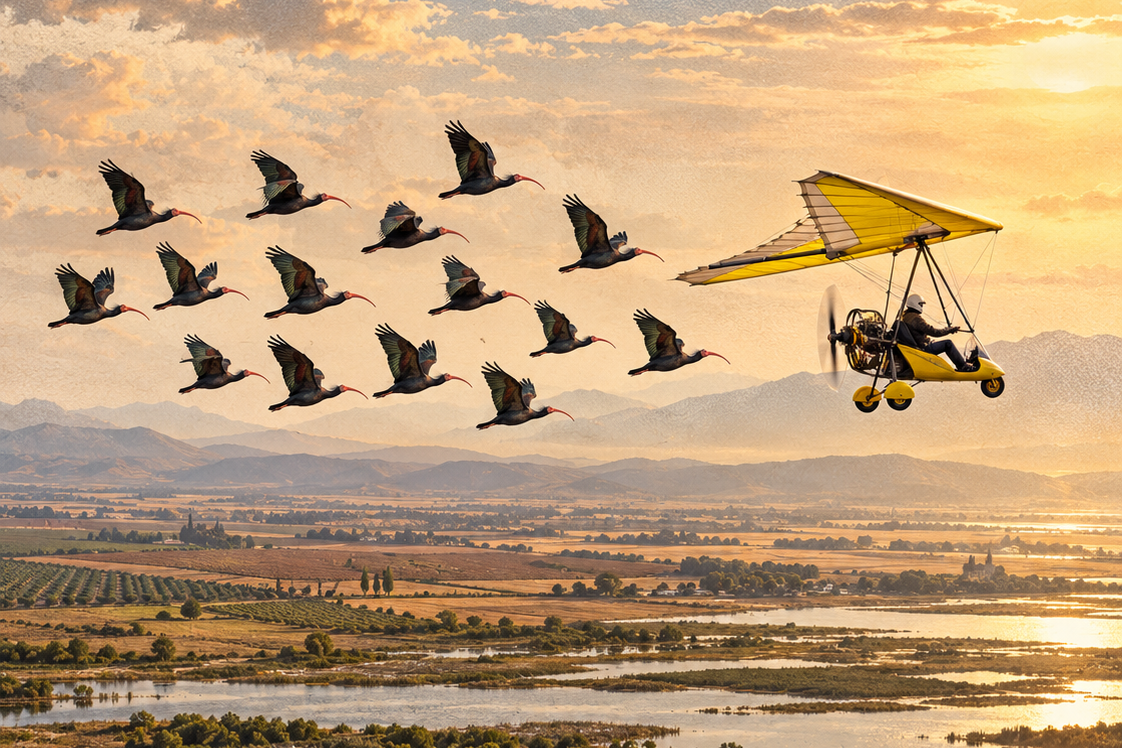
Fifteen northern bald ibises have joined a growing flock in Alt Empordà, Catalonia, after human foster parents guided them south behind a micro aircraft — another step in Europe’s long effort to restore a bird that vanished from the continent for roughly three centuries.
WHAT HAPPENED
The young birds were raised and trained to follow their human foster parents in flight. Guided by an ultralight, the group reached northern Spain and joined an established flock. The Catalonia project began in 2024, built a first-generation flock of nearly 60 birds by 2025, and released birds in March 2026. Its ten-year goal is at least 50 breeding pairs and about 300 wild birds, connected with other European colonies by migration.
WHY THIS IS HOPESLOP
This is conservation as patient choreography: people cannot simply release a migratory bird and hope it knows a lost route. They have to teach the sky itself. Fifteen birds following one small aircraft is strange, precise and deeply earned hope — a human-made bridge back to wild independence.
ORIGINAL SOURCEThe Guardian / WaldrappteamRead the original report
A DAILY ALLEGATION OF PROGRESS.
One good thing from the internet, every day. Nothing else.